
[Image source: The Monmouth County Historical Association, https://www.monmouthhistory.org/]
The roots of the Kinzie-Gordon clan’s saga began with waves of migration from Scotland to Britain’s North American colonies. The last name McKenzie (the original Kinzie family name), was quite common among these immigrants, as was the name Gordon. The earliest American Gordon of this family line married into the Rhea (Rhe) family, another common Scottish clan. They came for many different reasons – some were assigned to the colonies while serving with the British military, some were seeking economic and social advancement, while others were fleeing persecution.
But they never forgot their Scottish roots.
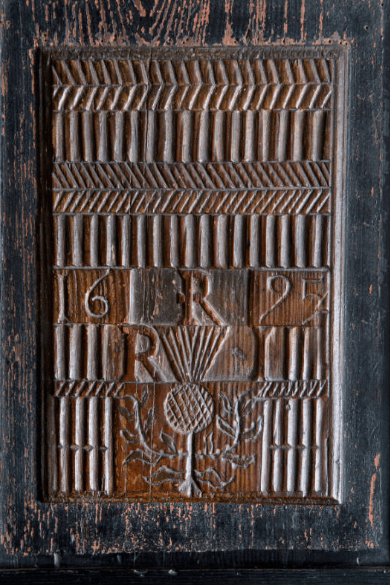
The image above is a close-up of the back of a chair carved by Juliette Gordon Low’s great-great-great-great grandfather Robert Rhea, a Quaker who had fled Scotland in the 1680s during a period when the British government was cracking down on all non-Anglicans. He married another Scottish Quaker refugee named Janet Hampton. Together they built a new life. Today this chair, believed to be the oldest known piece of colonial New Jersey furniture, is housed at the Monmouth County Historical Society. On their website, the curator explains the symbolism of the carving and how it relates to Scottish immigrant history:
“This chair follows the same structural form as those found along the Scottish east coast, from Aberdeen to the Scottish Borders. Its wide, flaring seat, curved pincer-like arms on column supports, decorated back and scrolled cresting are characteristic features of the caqueteuse pattern that took hold in Scotland during the sixteenth century. Many examples of this type survive in tower houses and museum collections, but the most representative anthology of these high-status chairs is at Trinity Hall, Aberdeen, where they were used ceremonially by the Deacons of the city’s seven Incorporated Trades. The inward-pointing scrolls of the New Jersey chair’s cresting rail connect it specifically with this Aberdeen group. The carved thistle, which is the central decorative feature of the back panel, became a national symbol of Scotland beginning in the first half of the fifteenth century and enjoyed prominence as a royal emblem on Scottish silver coinage of the reign of James III. The incised bands forming the ground of the back are more difficult to interpret as they do not appear on any other recorded Scots caqueteuse-type chair. Their appearance is most interesting because the nearest analogy is Ogham script, a cryptic alphabet of parallel strokes branching from straight lines that was used by people who lived in the northeast of Scotland between the fourth and sixth centuries.” – [https://monmouthhistory.emuseum.com/objects/96/wainscot-armchair]


Leave a comment