
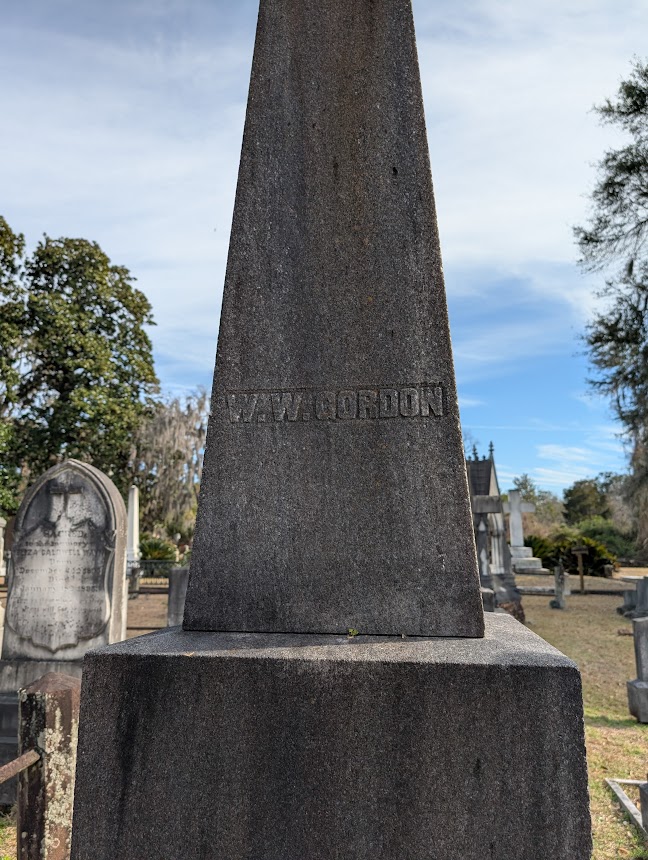
One of the most commonly visited burial sites in Savannah’s Laurel Grove Cemetery is that of Girl Scout founder Juliette “Daisy” Gordon Low. Her grave sits in a small family plot alongside those of her parents and siblings. Scattered throughout the cemetery are the resting places of several other Gordon family members, servants, and friends. One of the most interesting to me is that of Daisy’s paternal grandfather, William Washington “W.W.” Gordon I. Save for his barely legible name, the rest of the simple stone monolith has faded from view to the extent that one would have difficulty identifying the tomb as his were it not for the cemetery directory and the more clearly defined grave of his wife, Sarah Anderson “Addy” Stites Gordon, next to it.
The contrast between the faded headstone of W.W. Gordon and that of his granddaughter serves as a useful metaphor for changing views of “greatness.” W.W. Gordon was one of early 19th century Georgia’s leading political and business figures, responsible for the creation of the Central of Georgia Railroad. Following his untimely death, state leaders rushed to honor him with public monuments and even the naming of a county. During his lifetime he seemed obsessed with achieving “greatness,” to the extent that he often neglected his family’s emotional needs and exploited others, especially African Americans and Indigenous peoples, for his own gain.
Since the unlikely success of Daisy’s Girl Scouts, she has far eclipsed W.W. Gordon I as the most famous member of the family. As many Native American and African American Georgians can attest, in recent years there has been reconsideration of the complicated legacy W.W. Gordon left behind, focusing on the damage his actions caused to segments of society. Today few people outside the state even know who he was. For a man obsessed with achieving “greatness” based on the standards of his time, it is perhaps fitting that as those standards have faded, so has the marker of his death.


Leave a comment